Cracking the Code: The Hidden Meanings Baked Into Psychedelic Art's Most Iconic Symbols
You've probably stared at a piece of psychedelic art long enough to feel like it was staring back. That's not an accident. The artists who built this visual tradition — from the poster makers of Haight-Ashbury to the digital visionaries dropping NFTs today — weren't just chasing aesthetic fireworks. They were building a language. A secret one, more or less. And if you've been collecting this stuff without knowing the grammar, you've been reading a book by its cover this whole time.
Let's fix that.
The Eye: Surveillance, Divinity, and the Gaze That Goes Both Ways
Few symbols show up more consistently in psychedelic art than the eye — sometimes nested inside a triangle, sometimes floating in a sea of color, sometimes multiplied across a canvas until the whole thing feels like it's watching you from every angle. The disorienting effect is intentional.
The eye in psychedelic visual culture draws from multiple wells simultaneously. There's the ancient Egyptian Eye of Horus, a symbol of protection and royal power that got absorbed into Western occult tradition and eventually into counterculture iconography. There's the Illuminati-adjacent all-seeing eye that the 1960s underground co-opted partly as parody, partly as genuine spiritual provocation. And then there's the more personal interpretation — the eye as a stand-in for expanded perception itself, the idea that certain altered states literally change how you see the world.
When you see an eye dominating a piece, the artist is usually gesturing at all three of those meanings at once. It's about awakening, about being watched by something larger than yourself, and about the act of seeing as a radical, almost dangerous thing.
Fractals: Math as Mysticism
Here's where the Art & Science thing gets real. Fractals — those endlessly self-replicating geometric patterns that branch and recurse into infinity — became a psychedelic staple partly because they describe something that genuinely happens in the brain during altered states. Researchers studying visual hallucinations have documented fractal-like geometric patterns as among the most commonly reported perceptual phenomena. So when artists render fractals, they're not just making something trippy-looking. They're documenting something.
But the symbolism runs deeper than neuroscience. Fractals are also a visual argument that the universe is self-similar at every scale — that the pattern of a fern frond echoes the pattern of a river delta echoes the pattern of a galaxy arm. For a lot of people in psychedelic communities, that idea isn't just poetic. It's spiritual. It's the visual proof that everything is connected, which happens to be exactly the kind of insight that people report coming away from profound psychedelic experiences with.
Collectors who understand this tend to look at fractal-heavy work differently. It's not decoration. It's a cosmological statement.
Mandalas: The Circle That Contains Everything
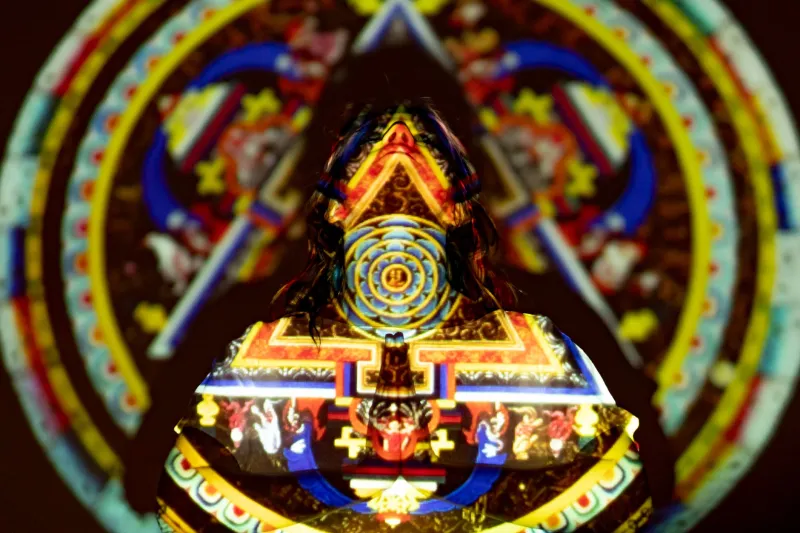
The mandala might be the most globally traveled symbol in psychedelic art. It shows up in Tibetan Buddhism, in Navajo sand painting traditions, in Carl Jung's psychological theory of the self, and eventually in the hands of artists like Alex Grey, whose work has become something close to canonical in psychedelic visual culture.
At its core, the mandala is a map — specifically, a map of the cosmos organized around a central point. The symmetry isn't just pleasing to look at; it's doing philosophical work. It's saying that everything radiates outward from a single source, and that the universe has an underlying order even when it looks chaotic.
In psychedelic art specifically, mandalas often get loaded with additional symbolism — deities, animals, geometric patterns that reference specific spiritual traditions. When you're looking at a mandala-based piece, it's worth asking what's at the center. That choice is almost never arbitrary. The center is the artist's answer to the question: what is everything organized around?
Geometric Patterns and Sacred Geometry: The Blueprint Beneath Reality
The Flower of Life. The Metatron's Cube. The Vesica Piscis. If you've spent any time in psychedelic art spaces — at festivals, in galleries, browsing shops like this one — you've seen these patterns. Sacred geometry is the idea that certain mathematical ratios and shapes are woven into the fundamental structure of the universe, and that by working with those shapes, you're touching something real and deep.
The appeal to counterculture communities is obvious. Sacred geometry offers a framework that's spiritual without being tied to any single religion, scientific without being reductive, and visually stunning in a way that lends itself perfectly to the psychedelic aesthetic. It's also, crucially, a kind of insider knowledge — if you recognize a Metatron's Cube, you're part of a community that cares about this stuff.
For collectors, pieces built around sacred geometry are often more rigorously intentional than they might appear. The proportions matter. The specific shapes chosen matter. An artist who knows their sacred geometry is making choices at every level of the composition that communicate a worldview.
Serpents, Spirals, and the DNA Connection
The double helix of DNA and the ancient symbol of the serpent have been on a collision course in psychedelic art for decades. Researchers like Jeremy Narby famously argued that the serpentine imagery reported by Amazonian shamans during ayahuasca ceremonies bore a striking resemblance to the structure of DNA — a claim that's controversial among scientists but irresistible to artists.
Serpents in psychedelic imagery carry the weight of multiple traditions: the Kundalini energy of Hindu practice (a coiled serpent at the base of the spine that rises through the chakras), the Ouroboros of alchemical tradition (the snake eating its own tail as a symbol of cyclical time and self-renewal), and the more contemporary idea of the serpent as a metaphor for the genetic code itself — the literal blueprint of life.
Spirals, which often appear alongside or instead of explicit serpents, carry similar freight. The spiral is growth, evolution, the structure of galaxies and seashells and hurricanes. When you see spiral motifs dominating a piece, you're usually looking at an artist working in the territory of transformation — the idea that consciousness, like everything else in nature, moves in spirals rather than straight lines.
Why This Matters for Collectors
Understanding this visual language doesn't just make you a more interesting person at gallery openings. It changes your relationship to the objects you own. A piece of psychedelic art on your wall isn't passive — it's an argument, a question, a map, or a message. The artists who made it were drawing on traditions that stretch back centuries and across cultures, and they were encoding meaning into every choice.
When you know that the eye is asking you to examine your own perception, or that the fractal is making a claim about the nature of reality, or that the mandala is a cosmological diagram — the art starts to do something different in your space. It stops being wallpaper and starts being a conversation.
That's what this culture has always been about, honestly. Not just looking at things differently, but understanding that the way you see is itself a kind of politics, a kind of spirituality, a kind of identity. The symbols are the shorthand for all of that. Now you've got the dictionary.