Own Nothing, Want Everything: The Strange Economics of Psychedelic Art Collecting
There's a particular kind of irony that lives at the intersection of psychedelic culture and the collector's market. The whole philosophical backbone of the movement — from the Haight-Ashbury commune scene to the underground rave flyers of the '90s — was built on radical sharing. Art for the people. Consciousness as a commons. And yet here we are, watching limited-edition prints from underground visionary artists sell for $4,000 on secondary markets while buyers argue in Discord servers about provenance and authenticity.
Welcome to the collectibility paradox. The more a piece of psychedelic art resists ownership, the more someone, somewhere, desperately wants to own it.
The Anti-Ownership Aesthetic Has Always Had a Price Tag
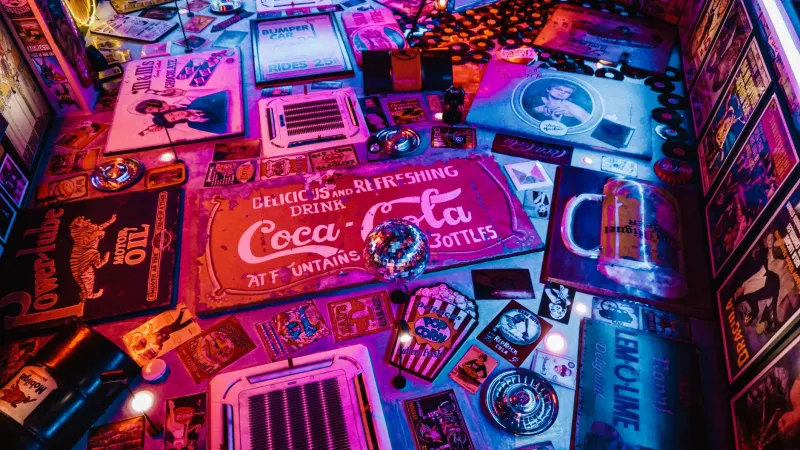
Let's not pretend this tension is new. Even in the 1960s, when San Francisco poster artists like Wes Wilson and Victor Moscoso were designing concert bills for the Fillmore and the Avalon Ballroom, those pieces weren't meant to be preserved behind glass. They were stapled to telephone poles. They got rained on. They were disposable by design.
And then, almost immediately, people started collecting them.
That gap — between what art is made for and what it becomes — is where the psychedelic market has always done its strangest work. The ephemerality wasn't a bug. For collectors, it became the feature. Rarity born from indifference is still rarity. Maybe it's even better rarity, because it carries a story about a culture that wasn't trying to manufacture scarcity. It just happened.
Fast forward to now, and that dynamic has become infinitely more complicated — and more deliberately engineered.
The Drop Culture Takeover
If you've spent any time in the world of independent psychedelic artists over the last five years, you've watched the underground drop model explode. Artists announce limited runs of prints — sometimes 50 copies, sometimes 10, sometimes just one — through Instagram stories or newsletter blasts that disappear after 24 hours. The scarcity isn't incidental. It's the whole point.
This is where things get philosophically messy. Underground artist drops borrow the language of anti-commercial culture — handmade, intentional, community-first — while operating on the exact same scarcity mechanics that luxury fashion brands use to make sneakers feel like artifacts. The difference, defenders will argue, is that the money goes directly to the artist. No gallery taking 50%. No institutional gatekeeping. Just a creator and their audience.
That's a real distinction. But it doesn't fully resolve the weirdness of watching a piece of art that was conceived as a spiritual offering become a speculative asset within six months of its release.
NFTs and the Metaphysics of Digital Ownership
Nothing accelerated the collectibility paradox quite like the NFT boom of 2021. Suddenly, psychedelic digital artists — many of whom had been giving their work away for free on Tumblr and DeviantArt for years — were minting tokens and selling them for sums that would have seemed hallucinatory even to the most optimistic among them.
The philosophical argument for NFTs in psychedelic art spaces was genuinely interesting: if the culture has always been about consciousness expansion, then maybe redefining what ownership even means is the next frontier. You're not buying a physical object. You're buying a verified relationship to a piece of work. A kind of digital covenant between artist and collector.
Critics, of course, had a field day. Owning a token that points to an image file is not the same as owning the image. The artwork itself remains infinitely reproducible. The scarcity is entirely constructed — a legal fiction dressed up in blockchain language. And in a culture that once burned its own hierarchies down for sport, creating a new class of digital art haves and have-nots felt, to many, like a profound betrayal.
Both sides had a point. The NFT wave eventually receded, but it left behind a permanently altered conversation about what psychedelic art collectors are actually purchasing when they buy into this world.
What Are You Really Buying?
This is the question that serious collectors in this space are increasingly forced to ask themselves. And the honest answers are more layered than most collecting discourse acknowledges.
Some buyers are purchasing access — to an artist's community, to future drops, to a sense of belonging in a subculture that still feels genuinely alternative even as it gets bigger. Others are purchasing story. The narrative of how a piece came to exist, who made it, what tradition it draws from, why it was made in an edition of seven — that backstory is often worth as much as the object itself.
And then there's the philosophical buyer, the one who's thought hardest about the paradox. These collectors will tell you that owning a piece of visionary art is less like owning a car and more like being a temporary steward of something that was always meant to move through the world. They're not accumulating. They're holding, for a while, before passing it on.
Whether that framing is genuine wisdom or very expensive rationalization probably depends on who's doing the framing.
The Scarcity That Spirituality Created
Here's the twist that doesn't get discussed enough: some of the most valuable psychedelic art in circulation became rare for reasons that had nothing to do with market strategy. Pieces were made in small numbers because the artist was broke, or because the print run was funded by a small commune, or because the whole project existed outside commercial infrastructure entirely. The scarcity was a byproduct of living outside the system — and now the system has decided that byproduct is worth a lot of money.
There's something almost poetic about it, if you squint. The art that most aggressively rejected commodity culture has become a commodity precisely because of that rejection. The underground has always been the R&D department for the mainstream, and the psychedelic art market is just the latest proof.
Where Does That Leave the Rest of Us?
Not everyone can spend thousands on a visionary art print or navigate the whiplash of a 48-hour drop. And that's a real tension for a culture that has always at least aspired to accessibility. The best artists working in this space seem genuinely aware of it — releasing some work as open-edition prints or digital downloads while keeping other pieces limited. A tiered model that tries to honor both the economics of making art and the ethics of sharing it.
It's imperfect. Most honest solutions are.
What the collectibility paradox ultimately reveals is that psychedelic culture was never as post-capitalist as it imagined itself to be. It was always making things of value. The question it's still working out — loudly, messily, in real time — is who gets to decide what that value means, and who gets to hold it.
That's a question worth sitting with. Even if you can't afford the print.