Wear Your Revolution: How Street Artists Are Making Psychedelic Fashion a Political Act
There's a jacket circulating in certain corners of Brooklyn right now. Hand-painted, one-of-one, covered in swirling eyes and fractured geometry that seems to shift depending on how the light hits it. The artist who made it — a 24-year-old who goes by Solara and sells exclusively through Instagram DMs — has a waitlist of over 300 people. She's turned down licensing deals from two mid-tier streetwear brands. She's not interested in scaling up.
"The whole point," she said in a recent conversation, "is that you can't just buy your way into this. You have to actually want it."
That tension — between authenticity and accessibility, between art and commerce, between the underground and the mainstream — is exactly where psychedelic street fashion lives right now. And it's one of the most electric spaces in American style.
Clothes That Say Something
Psychedelic fashion has always carried a message. From the hand-dyed threads of the late '60s to the rave gear of the '90s, putting these aesthetics on your body was never purely decorative. It was a declaration. You were announcing something about how you saw the world — or at least how you wanted to see it.
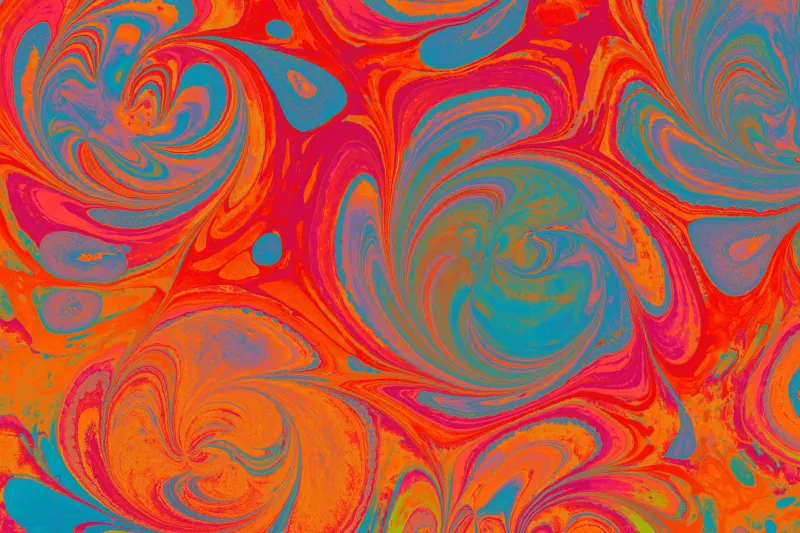
What's different in 2024 is the specificity of that declaration. Today's underground designers aren't just reaching for trippy visuals because they look cool. They're using the language of psychedelic art — the fractal patterns, the impossible color combinations, the imagery that seems to breathe — to make pointed statements about identity, mental health, bodily autonomy, and the sheer refusal to participate in a culture that keeps trying to sand everyone down to the same beige finish.
Denver-based designer Marcus Trell, who runs a micro-brand called Chromaflux, describes his process as "political art that happens to be wearable." His recent drop — a limited run of 40 hand-screened hoodies featuring a design that references both Alex Grey's anatomical mysticism and protest poster aesthetics — sold out in under three hours. Each piece came with a QR code linking to a zine about the relationship between psychedelic therapy access and healthcare inequality.
"I want people to put on the hoodie and feel something," Trell says. "But I also want them to think something. The art is the entry point."
The Drop Culture Difference
One of the biggest structural shifts in underground psychedelic fashion is the embrace of the limited drop model — not as a hype-building marketing gimmick, but as a genuine philosophical stance against mass production.
When a designer releases 30 pieces and they're gone, that's it. No restocks, no colorway variations, no watered-down version at a lower price point six months later. The scarcity isn't manufactured drama. It's the natural result of one person making things by hand, at their own pace, on their own terms.
This runs completely counter to how fast fashion has tried to absorb psychedelic aesthetics. You've seen it — the big-box store tie-dye sections, the algorithmically generated "trippy" prints slapped onto $12 crop tops, the festival wear aisles that look like someone fed a blacklight poster through a content farm. It's psychedelic imagery stripped of any actual meaning, reproduced at industrial scale, and sold to people who mostly just want to look like they get it without doing any of the work.
The underground has noticed. And the underground is not impressed.
"Corporate psychedelia is like a photograph of a fire," says Los Angeles-based textile artist Yara Osei, who specializes in hand-painted denim. "It looks like the thing, but it gives off no heat."
Gen Z Is Not Here for the Knockoff
Here's what's fascinating about the current moment: the generation that grew up with infinite digital access to everything is the one most aggressively seeking out the handmade, the limited, the genuinely weird.
Gen Z consumers — particularly those orbiting the psychedelic culture space — have developed remarkably sophisticated taste detectors. They can clock a corporate co-opt from a mile away, and they're vocal about it. TikTok and Instagram have created a kind of distributed authentication system where underground designers get signal-boosted and fast-fashion imitators get publicly dragged.
But beyond just rejecting the fake stuff, Gen Z is using psychedelic fashion as a genuine identity architecture tool. The way previous generations might have used band tees or political buttons to signal who they were, today's young people are using psychedelic aesthetics to communicate whole worldviews — openness to altered states of consciousness, interest in mental health conversations, alignment with environmental and social justice causes, and a fundamental rejection of the idea that you have to choose between being interesting and being good.
"It's not costume," explains 22-year-old Priya Vasquez, a Chicago-based art student who customizes thrifted clothing with psychedelic imagery. "When I paint something on a jacket, I'm saying: this is how I process the world. This is what's going on inside my head. It's basically a self-portrait I can wear."
DIY as Doctrine
The DIY customization scene deserves its own spotlight here, because it's arguably the purest expression of what psychedelic fashion is actually about. Across the country, people are picking up fabric paint, bleach, embroidery thread, and heat transfer vinyl and turning thrifted finds into one-of-a-kind pieces that no brand could ever replicate — because they come directly from a specific person's specific inner world.
This isn't just a craft hobby. For a lot of people, it's a practice. The act of sitting down and painting something from your mind onto a piece of clothing is its own kind of meditation, its own kind of meaning-making. And the resulting piece carries that energy in a way that a mass-produced item simply cannot.
There's also something quietly radical about the thrift-and-customize pipeline. It's a direct rebuke to the consumption cycle — taking something discarded, transforming it with your own vision, and putting it back into the world as something new. That's a psychedelic concept in the most literal sense: taking what exists and fundamentally changing how you perceive it.
Why the Underground Keeps Winning
Corporate fashion keeps trying to crack the psychedelic code, and it keeps missing the point. Because the point was never the pattern. The point is the intention behind the pattern. The point is the person who spent 40 hours painting a jacket because they needed to get something out of their head and onto fabric. The point is the community that forms around a designer who actually believes in what they're making.
You cannot manufacture that at scale. You cannot A/B test your way to authenticity. And Gen Z — along with everyone else who actually cares about this stuff — knows the difference immediately.
Solara, the Brooklyn jacket artist with the 300-person waitlist, summed it up cleanly: "When someone's wearing one of my pieces, they're not just wearing art. They're wearing a whole conversation. A whole set of values. You can't get that from a drop-shipper."
The psychedelic fashion underground isn't fighting for market share. It's fighting for meaning. And right now, meaning is winning.