Sold on the Spiral: What Happens When Corporate America Discovers Your Aesthetic
Sold on the Spirit: What Happens When Corporate America Discovers Your Aesthetic
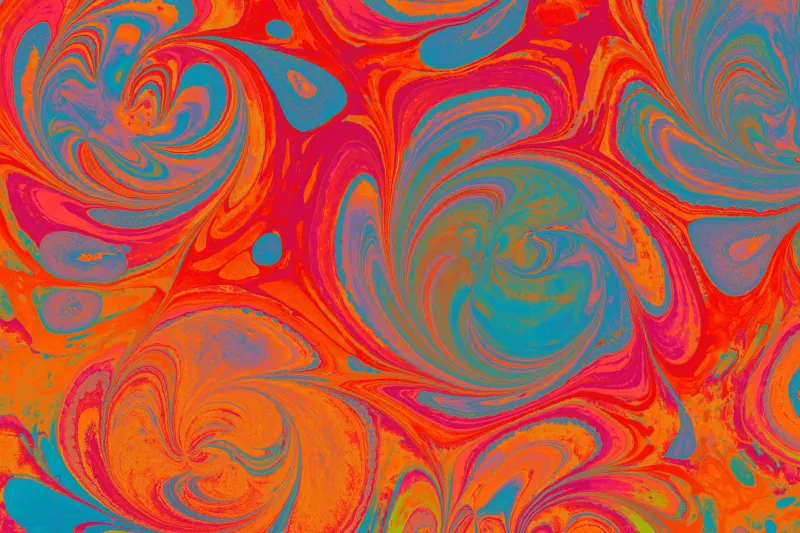
Picture this: you're standing in the checkout line at a gas station somewhere in middle America, and the energy drink cooler to your left looks like it was designed by someone who just finished reading a manifesto about the 1967 Summer of Love. Swirling chromatic gradients. Melting letterforms. Color palettes that seem to vibrate against each other. The can doesn't say anything remotely countercultural — it's promising you focus, or energy, or some proprietary blend of adaptogens — but it's dressed in the visual vocabulary of a Fillmore poster.
This is the world we live in now. And if you've spent any time in spaces where psychedelic art is taken seriously, you've probably had some feelings about it.
The Takeover You Didn't Fully Notice
The corporate adoption of psychedelic visual language has been building for years, but it's accelerated dramatically in the last half-decade. It's not just energy drinks. Tech startups are using fluid, morphing logo systems that owe an obvious debt to liquid light shows. Athletic apparel brands are running campaigns built around iridescent color transitions and optical illusion patterns. Streaming platforms are using trippy, kaleidoscopic motion graphics to promote content that has nothing to do with altered states of any kind.
Even sectors you wouldn't necessarily associate with countercultural aesthetics — financial services, insurance, fast food — have been experimenting with chromatic gradients and pattern work that would have looked completely at home on a 1969 album cover.
The people designing this stuff aren't naive about what they're doing. Brand designers interviewed for this piece were remarkably candid about the deliberate nature of these choices. "Psychedelic visual language reads as authentic, creative, and slightly rebellious without actually committing to any of those things," says one creative director at a mid-sized branding agency in Austin who works with consumer packaged goods clients. "It gives brands a way to signal that they're interesting without taking any real risks."
That's a pretty honest summary of the appeal. And it points directly at what makes the whole phenomenon feel uncomfortable to people who came to this aesthetic through a different door.
What Gets Lost in Translation
Psychedelic art didn't emerge in a vacuum. It grew out of specific communities, specific political moments, and specific experiences that the visual language was designed to evoke or communicate. The swirling typography of Wes Wilson's Fillmore posters wasn't just a stylistic choice — it was a visual declaration that straight society's rules about legibility and order didn't apply here. Victor Moscoso's deliberately clashing complementary colors were meant to create a physiological effect in the viewer, a mild visual vibration that gestured toward perceptual transformation.
When a tech startup lifts those visual strategies to sell project management software, the form remains but the content evaporates. The aesthetic becomes decoration. And there's a real argument that this process doesn't just dilute the original meaning — it actively works against it, because the corporate context reframes the visual language as a marker of consumption rather than resistance.
This is what cultural theorists sometimes call "recuperation" — the process by which dominant culture absorbs and neutralizes the challenge posed by subcultural aesthetics. It happened to punk in the 1980s. It happened to hip-hop in the 1990s. And it's happening to psychedelic visual culture right now, in real time, at the speed of the modern branding cycle.
The Democratization Counterargument
But the story isn't entirely one-directional, and it's worth taking seriously the case that corporate adoption of psychedelic aesthetics isn't purely a loss.
For one thing, it creates exposure. When a major streaming service uses trippy, visually complex motion graphics in its UI, it's introducing millions of people to a visual language they might then go looking for in its original contexts. Some percentage of those people will end up discovering Moscoso, or the Family Dog collective, or the contemporary artists who are working in and extending the psychedelic tradition. That's not nothing.
For another, the relationship between commerce and counterculture has always been more complicated than the clean narrative of corporate co-optation suggests. The original psychedelic poster artists were commercial illustrators. Bill Graham was a promoter who charged admission. The underground press ran ads. The idea of a pure, uncommercialized psychedelic culture existing before the corporations showed up is largely mythological.
"Every aesthetic gets commercialized eventually," says one independent artist who sells through her own direct-to-consumer platform. "The question isn't whether it happens — it's whether the original community maintains enough creative vitality to keep evolving beyond what the mainstream is copying. When corporations are ripping off something you did three years ago, that means you've already moved on to something they haven't caught up to yet."
There's genuine wisdom in that framing. The psychedelic aesthetic that corporate brands are currently mining is, in most cases, a version of the aesthetic that was culturally dominant ten or fifteen years ago. The artists actually driving the culture forward right now are working in territory that looks quite different — more influenced by digital glitch aesthetics, non-Western psychedelic traditions, and the specific visual languages emerging from contemporary psychedelic research communities.
What It Means for Collectors and Enthusiasts
For people who collect psychedelic art, wear it, live with it, and genuinely care about the culture it comes from, the corporate encroachment creates a practical problem: it muddies the signal. When the visual language of psychedelia becomes ubiquitous enough that it appears on gas station energy drinks, it becomes harder to communicate what you actually mean when you choose to surround yourself with it.
This is partly why the market for authentic vintage psychedelic art has been strengthening — there's a growing premium on work that predates the current corporate moment, work that carries genuine provenance and cultural context. It's also why there's increasing interest in contemporary psychedelic artists who are doing work complicated enough that it can't be easily stripped for parts by a brand team.
The corporate co-optation of psychedelic aesthetics is real, it's ongoing, and it does cost something. But it's also, in a strange way, a testament to the enduring power of this visual tradition. Corporations don't spend money trying to absorb aesthetics that don't have genuine cultural charge. The fact that they want it so badly is evidence that it still means something — and that the communities who built it have every reason to keep pushing it somewhere new.
The spiral keeps moving. The question is whether you're following the brands, or whether you're out ahead of them.