Real or Rendered? How AI Is Breaking the Psychedelic Art Market's Brain
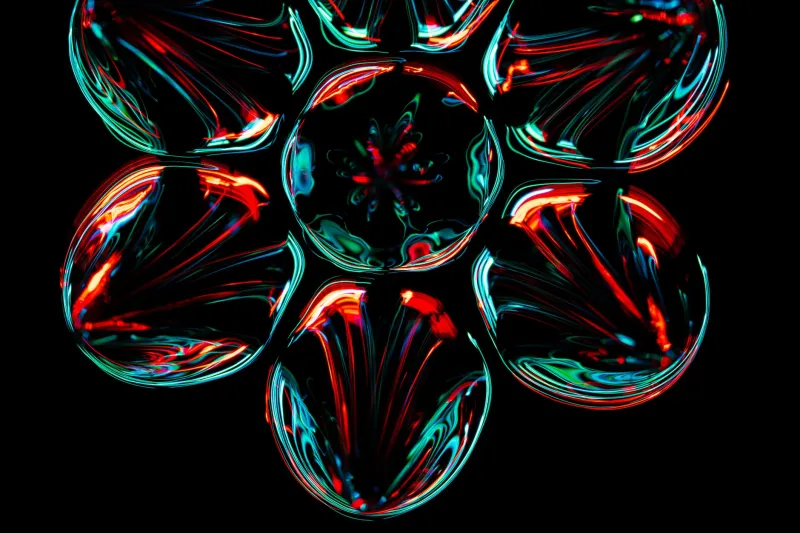
There's a screenshot making the rounds in collector Discord servers and Reddit threads right now. It shows two pieces of art side by side — dense, fractal-heavy, kaleidoscopic compositions dripping with the kind of visual intensity that makes your retinas feel like they're auditioning for a Pink Floyd laser show. One was painted by a human artist over the course of three months. The other was generated by a Midjourney prompt in about forty-five seconds.
Most people can't tell which is which.
That's the problem. And depending on who you ask in the psychedelic art world, it's either an existential threat or a fascinating new frontier — with very few people landing comfortably in the middle.
The Machine Learned to Trip
AI image generation tools — Midjourney, Stable Diffusion, DALL-E, and a growing list of competitors — have gotten terrifyingly good at mimicking the visual grammar of psychedelic art. The recursive geometry, the impossible color harmonies, the sense that the image is breathing even when it's standing completely still. These aren't accidents. These systems were trained on massive datasets that almost certainly included decades of psychedelic art, from 1960s concert posters to Alex Grey's anatomical dreamscapes to the kind of digital fractal art that's been a staple of the counterculture internet since the early 2000s.
The result? A machine that has, in a purely technical sense, internalized the visual language of consciousness expansion — without ever having expanded a single neuron of consciousness.
For collectors, that distinction matters. Or at least, it used to.
What Are You Actually Buying?
When someone drops serious money on a piece of psychedelic art — whether that's a hand-painted canvas, a limited-edition print, or a one-of-one digital token — they're typically buying more than pixels or paint. They're buying a story. They're buying the idea that a human being, often one who has walked some genuinely strange and transformative inner roads, translated an experience into a visual form that you can hang on your wall or display on your screen.
That narrative has always been central to how psychedelic art gets valued. The biography of the artist matters. The intention behind the work matters. The idea that something real passed through a real nervous system on its way to becoming that image — that's the whole point.
AI collapses that story completely. There's no nervous system. No intention. No 3 a.m. revelation that had to get out of somebody's head and onto a canvas. There's a prompt, a server farm, and a render queue.
So what exactly is a collector paying for when they buy an AI-generated piece? That question is currently breaking the brains of everyone from gallery curators to casual buyers browsing Etsy.
The Authentication Arms Race
The psychedelic art community hasn't just thrown up its hands. Collectors, artists, and platforms are actively developing new frameworks for establishing provenance and authenticity in an AI-saturated market.
Some of the approaches gaining traction:
Blockchain-based provenance records. NFT infrastructure, whatever you think of the hype cycle that surrounded it, does offer something genuinely useful here: an immutable record of where a piece came from and who made it. A growing number of digital psychedelic artists are minting their work with detailed metadata that documents their process — including references to source sketches, time-lapse recordings, and signed artist statements.
Process documentation as proof of life. Human artists are increasingly releasing the receipts. Time-lapse videos, sketchbook scans, studio photos, and even voice memos recorded during the creative process are becoming part of the package when a piece goes to market. The logic is simple: AI doesn't have a sketchbook.
Community-based vetting. Several collector communities have organized informal authentication panels — experienced collectors and artists who review submitted works and offer consensus opinions on likely human versus AI origin. It's not scientific, but in a market that's always run partly on reputation and relationships, community trust still carries weight.
AI detection tools. Yes, there are now AI tools designed to detect AI-generated art. The irony is not lost on anyone. Tools like Hive Moderation and various open-source classifiers can flag statistical patterns common in generated images. They're imperfect and getting less reliable as generation quality improves, but they're part of the toolkit collectors are reaching for.
The Harder Question Nobody Wants to Answer
Here's where it gets philosophically messy, and where the psychedelic art community's own values start to complicate the conversation.
Psychedelic culture has historically been skeptical of gatekeeping. The whole ethos — from the free concerts of the '60s to the open-source sharing culture of digital art communities — has leaned toward accessibility, democratization, and the idea that visionary experience shouldn't be locked behind credentials or institutional approval.
But authentication is, by definition, a gatekeeping mechanism. It says: this is real, that is not. This counts, that doesn't.
Some voices in the community are pushing back on the authentication panic entirely. If an AI-generated image genuinely moves you — if it opens something up in your perception, sparks a sense of wonder, makes you feel like you're looking at something from the edge of consciousness — does it matter that a human didn't make it? Is the experience less real because the process was algorithmic?
Others find that argument infuriating. They point out that it conveniently ignores the economic reality: human artists who have spent years developing their craft, building audiences, and pouring genuine experience into their work are now competing in a marketplace flooded with near-identical imagery produced at zero cost. The philosophical question of experiential validity is a luxury concern. The economic question of artist survival is not.
Where the Market Is Actually Heading
Reality check: AI-generated psychedelic art is not going away. The tools are too good, too accessible, and too fun for that to happen. What's more likely is a bifurcation of the market.
At one end: a premium tier of human-made work, where provenance documentation, artist reputation, and community authentication create a kind of certified-organic status that commands higher prices precisely because it's verifiable.
At the other end: a massive, affordable, and frankly enjoyable market for AI-generated visuals — prints, phone cases, tapestries, digital downloads — where buyers aren't necessarily claiming to own a piece of human artistic consciousness. They just want something beautiful and weird on their wall.
Both can coexist. They probably have to.
What can't survive the transition is willful ignorance — selling AI work as human-made, or buying without asking questions. In a community built on the idea of expanded awareness, the least we can do is stay awake to what we're actually looking at.
The universe is weird enough without letting the machines gaslight us about it.