Infinite Headspace: How VR Artists Are Building Psychedelic Worlds You Can Actually Step Inside
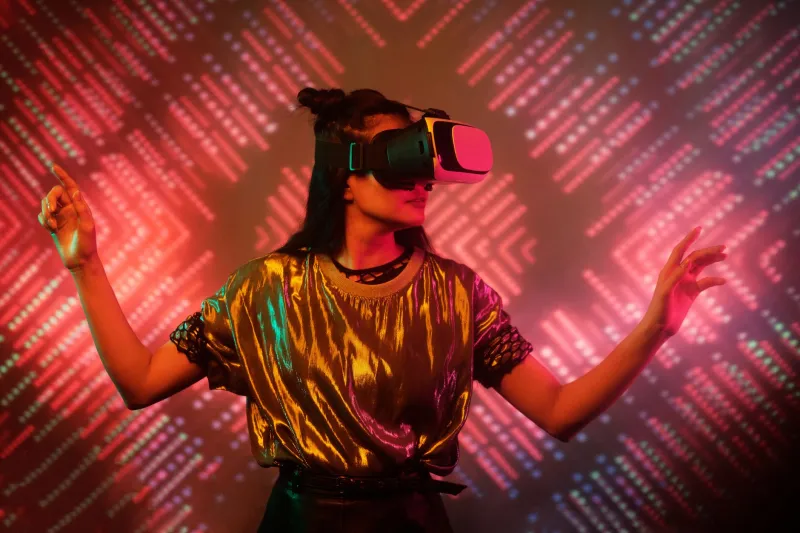
There's a moment, maybe thirty seconds after you strap on a headset and load into one of Marcus Veil's digital environments, where your brain quietly stops arguing with your eyes. The geometric lattice surrounding you pulses in colors that don't have names yet. The floor breathes. Something that looks vaguely like a jellyfish made of cathedral windows drifts past your left shoulder. You reach out instinctively, and your hand disappears into it.
This is not a game. This is not a screensaver. According to Veil — a self-taught VR artist based out of Portland, Oregon — this is a painting.
"People keep trying to file what I do under 'tech' or 'gaming,' and I get why," he says. "But the intention is the same as any artist standing in front of a canvas. I'm trying to create a specific feeling in a specific person. The tools just happen to be spatial."
Veil is one of a growing number of American artists who've ditched the flat plane entirely and relocated their practice into virtual reality. And they're not alone in taking the work seriously. Collectors, curators, and even a handful of institutional spaces are starting to pay attention — not just as a novelty, but as a legitimate frontier for psychedelic art.
Why VR and Psychedelic Aesthetics Are a Natural Match
Psychedelic art has always been about dismantling the ordinary. From the melting letterforms on 1960s Fillmore posters to the fractal-dense digital prints circulating on platforms like Psychedelic Made today, the whole project is about rewiring visual perception — making the viewer feel like their brain got a firmware update they didn't consent to.
VR does that by default. The technology hijacks your proprioception, your sense of spatial depth, your peripheral vision. It's the only medium where you can architect an experience that surrounds someone on every axis simultaneously. For artists working in a visual language built around altered states, that's not a gimmick. It's the logical next step.
"Flat psychedelic art asks you to imagine the depth," says Leila Okafor, a Chicago-based digital artist whose VR installations have shown at independent festivals in Austin and Brooklyn. "In VR, I can just give you the depth. You don't have to meet me halfway. You're already inside the thing."
Okafor's environments tend to operate on a slow, meditative rhythm — color fields that shift over minutes rather than seconds, architecture that seems to grow organically around the viewer. She describes the experience she's chasing as "the feeling right before a thought fully forms." Viewers have reportedly stood inside her pieces for upward of forty minutes without realizing it.
The Studio Is Now a Universe
Building these environments requires a toolkit that would've seemed like science fiction to the artists who defined the psychedelic aesthetic half a century ago. Programs like Tilt Brush, Quill, and Unreal Engine give VR artists the ability to sculpt in three-dimensional space, paint with light, and animate entire ecosystems of visual elements. Some artists work in fully virtual studios — building their art from inside VR itself, sculpting geometry with hand controllers the way a traditional sculptor might use their hands.
Jordan Reyes, a New Mexico-based artist who came to VR from a background in large-scale murals, describes the shift as both liberating and slightly terrifying.
"With a mural, I know the wall is thirty feet wide. I know where it ends," he says. "In VR, I'm working in a space that is literally infinite. I have to make choices about scale that nobody has ever had to make before. Do I make the viewer feel enormous or microscopic? Both? The decisions are completely different."
Reyes recently completed a commission for a private collector in Los Angeles — a custom VR environment designed to function as a personal meditation space. The collector accesses it through a standalone headset, spending time inside the work the way someone might sit with a painting they love, except the painting extends in every direction and responds subtly to their presence.
Owning Something You Can't Touch
That last detail — the commissioned, privately owned VR environment — points toward one of the more genuinely interesting developments happening in this space right now. How do you own a virtual world?
The answer, increasingly, involves blockchain-based certificates of authenticity that function less like NFT speculation and more like traditional provenance documentation. The collector in LA doesn't own a JPEG. They own a cryptographically verified, one-of-one digital environment that exists nowhere else and can only be accessed through credentials linked to their ownership record.
"It's closer to owning a building than owning a photograph of a building," Reyes explains. "The certificate proves you have the keys."
Okafor has structured her VR pieces similarly. Each installation exists as a single authenticated edition. When she sells one, she retains no copy. The buyer gets the environment, the source files, and a documented chain of custody. "I wanted to make sure the scarcity was real," she says. "Not artificial scarcity for hype. Actual scarcity because there's only one."
This model is attracting a different kind of collector than the speculative NFT boom drew a few years back — people who are interested in the experience itself, not the resale market. Collectors who want to live inside their art, not flip it.
Gallery Walls Are Getting Weird (In the Best Way)
Physical gallery spaces are also beginning to figure out how to incorporate VR psychedelic work without it feeling like a tech demo. Independent venues in cities like Denver, Seattle, and Miami have started dedicating dedicated headset stations to VR art alongside traditional hanging pieces. A few have experimented with shared VR experiences where multiple viewers can enter the same environment simultaneously — essentially turning the gallery visit into a collective trip through someone else's imagination.
The challenges are real. Headset hygiene is genuinely unglamorous. Session lengths have to be managed. Not every viewer is comfortable with full immersion. But the artists working in this space tend to view those friction points as part of the conversation rather than deal-breakers.
"Every medium has friction," Veil points out. "Oil paint dries weird. Film burns. Marble cracks. VR headsets make your face sweaty. That's not a reason to dismiss the work."
What Comes Next
The technology is moving faster than the art world's ability to categorize it, which is honestly the most psychedelic thing about all of this. Lighter headsets, higher resolution displays, and the slow creep of spatial computing into everyday devices are going to make immersive art more accessible without necessarily making it more mainstream in the watered-down sense.
For the artists already building inside these infinite spaces, the goal was never mass market penetration. It was always the same thing psychedelic art has always been after — the chance to hand someone an experience that cracks their ordinary perception open, just a little, and lets something stranger and more alive come flooding in.
The living room just became the portal. All you have to do is step through.