Ink Deep: How Psychedelic Tattoo Artists Are Turning Skin Into Sacred Geometry
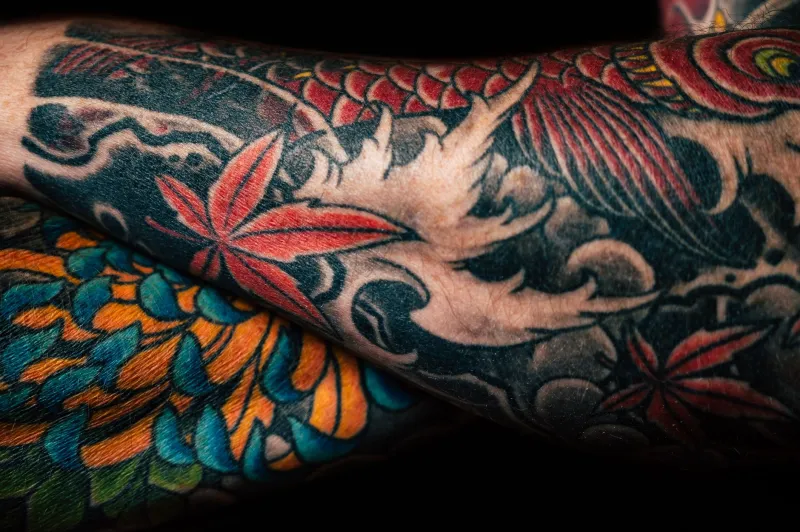
There's a particular kind of collector who looks at a framed piece on a gallery wall and thinks, that's not close enough. They don't want to hang the art — they want to become it. And right now, an entire wave of tattoo artists across the US is ready to make that happen, armed with machines, pigment, and a working knowledge of fractal mathematics that would make your high school geometry teacher deeply uncomfortable.
Psychedelic tattooing isn't new. The counterculture always had a relationship with permanent ink. But what's happening right now feels categorically different — less biker-bar flash sheet, more immersive installation you carry on your arm to the grocery store.
From Flash to Fractal
Walk into a conventional tattoo parlor in, say, 1985, and your psychedelic options were pretty limited. Maybe a mushroom. Maybe a yin-yang if you were feeling philosophical. The aesthetic vocabulary was narrow, and the technical tools were even narrower.
Fast-forward to today and you've got artists like those working out of studios in Portland, Austin, and Brooklyn who are essentially applying chaos theory to skin. We're talking Mandelbrot-adjacent spirals that appear to rotate when you look at them too long. Geometric tunnels that suggest infinite depth on a two-dimensional surface. Color gradients so precise they produce the same mild optical confusion as staring at a Bridget Riley painting.
The shift happened in layers. Digital design tools let artists prototype complex compositions before a single needle touches skin. A global community of tattoo enthusiasts sharing work on Instagram created cross-pollination between styles that would never have met in a pre-internet world. And the broader psychedelic renaissance — driven by renewed scientific interest in consciousness-expanding substances and their therapeutic potential — brought a whole new generation of people to the aesthetic who were actively looking for ways to wear their cosmology.
The Technical Nightmare (That Artists Love)
Here's the part the Instagram posts don't show you: translating psychedelic imagery onto skin is extraordinarily difficult. Like, technically punishing in ways that would make a muralist sweat.
Skin isn't canvas. It moves, breathes, ages, and sits differently on every person. A line that looks razor-sharp in a digital mockup can bleed and soften over time depending on where it's placed, how deep the ink goes, and the unique chemistry of the person wearing it. Geometric precision — the kind required to make a sacred geometry pattern read correctly — demands consistency that the medium actively resists.
Color is its own battle. The chromatic illusions that make psychedelic art visually destabilizing depend on specific relationships between hues. Certain pigments fade faster than others. UV exposure changes the equation. What looks like a vibrating red-green boundary on day one might settle into something muddier by year three. Artists working in this space spend enormous amounts of time studying pigment behavior, healing timelines, and placement strategy — because the piece has to hold up for decades, not just for the photo shoot.
Some artists have started approaching the longevity problem as part of the design itself, building compositions that anticipate how they'll age — engineering the fade, essentially, so the tattoo evolves rather than deteriorates. That's a level of long-game thinking that most art forms don't require.
Why Your Body Is the Ultimate Collection
For collectors in the psychedelic art world, there's a philosophical dimension to tattooing that conventional art ownership can't touch. A print on your wall is yours, sure — but it's also separate from you. It stays home when you leave. It can be sold, stolen, or damaged. It exists in a room.
A tattoo exists in you. The relationship is fundamentally different. Collectors who have moved into body art often describe it in terms of integration rather than acquisition — it's less about owning something beautiful and more about becoming it. For a community that's drawn to art as a tool for expanding consciousness and questioning the boundaries of self, that distinction matters a lot.
There's also something democratizing about it. The psychedelic art market — especially for original pieces by recognized artists — can be brutally expensive and gatekept. But a skilled tattoo artist, even one with a serious waiting list, is operating in a different economic register than a gallery. You're not buying a commodity that will appreciate in a portfolio. You're commissioning an experience.
The Artists Rewriting the Rules
The names leading this movement tend to be people who came up through traditional tattooing but got restless. They studied sacred geometry, optical art, and the visual grammar of psychedelic experience — not to copy what they saw but to understand why it works on the nervous system.
A recurring conversation in this community is about intentionality. The best psychedelic tattoo artists aren't just making pretty patterns. They're thinking about how the placement on the body interacts with the image — a spiral that follows the curve of a shoulder, a geometric mandala positioned over the sternum, a fractal that wraps a forearm in a way that seems to shift as the arm moves. The body becomes compositional architecture.
Some artists are also pushing into color theory territory that's genuinely experimental. Simultaneous contrast effects — where two colors placed next to each other appear to vibrate or shift — require the kind of precision that's hard enough on paper. On skin, with all its variables, it's a different challenge entirely. The artists who are pulling it off are developing techniques that don't exist in any textbook.
The Permanence Is the Point
Something worth sitting with: in a culture increasingly defined by the temporary, the disposable, and the infinitely scrollable, choosing to permanently alter your body with visionary art is a radical act of commitment. It's a statement that this matters enough to be irreversible.
For a lot of people in alternative and counterculture communities, that permanence isn't a drawback — it's the entire appeal. It's the opposite of the algorithmic churn of content, the opposite of fast fashion, the opposite of the vibe-of-the-month aesthetic cycle. A psychedelic tattoo is a flag you plant in your own skin that says: this is where I stand.
And honestly? As the psychedelic art world continues to expand — into galleries, into fashion, into therapy rooms, into mainstream consciousness — there's something genuinely exciting about the fact that the most intimate version of it is happening on bodies. Not in a museum. Not behind a velvet rope. Not for sale on a secondary market.
Just ink, skin, and a universe you decided to carry with you everywhere you go.