Turn Your Home Into a Headspace: The Collector's Guide to Psychedelic Interior Design
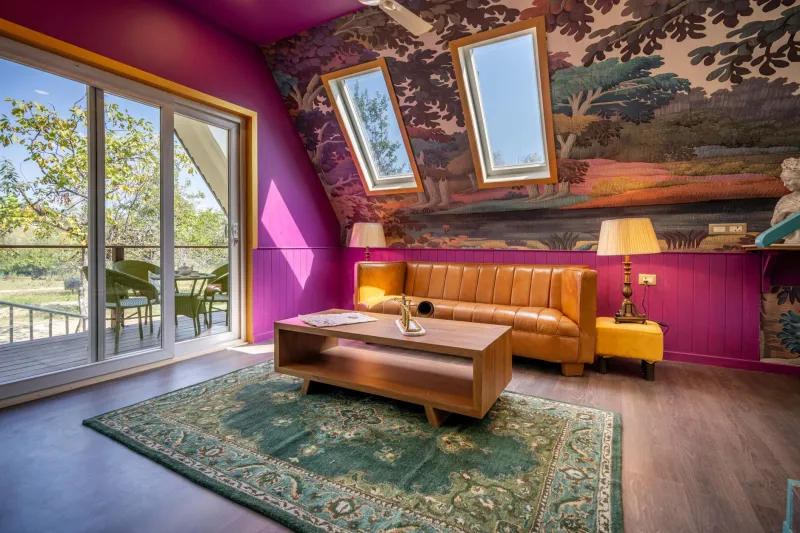
There's a version of psychedelic home design that's basically a Hot Topic clearance bin. Tapestries from Amazon, a lava lamp someone bought ironically, maybe a Grateful Dead poster that came pre-framed. It looks like a dorm room that peaked in 2009. And then there's the other version — the kind of space that stops you in the doorway, rearranges something behind your eyes, and makes you feel like you're thinking differently just by standing inside it.
The gap between those two outcomes isn't money. It's intention. And it turns out, the science of why psychedelic design affects us the way it does is a lot more interesting — and useful — than most interior decorating content will ever admit.
Your Brain Is Already Halfway There
Before you move a single piece of furniture, it helps to understand what's actually happening when your nervous system encounters psychedelic visual language. Researchers studying non-ordinary states of consciousness have documented something called neural cascade effects — basically, certain visual inputs trigger broader activation across sensory processing regions than everyday imagery does. High-contrast color combinations, recursive fractal patterns, and compositions that deliberately resist easy depth perception all tend to produce this effect.
In plain English: your brain works harder, engages more fully, and often reports feeling more present when surrounded by this kind of visual environment. That's not mysticism. That's neuroscience being accidentally useful for home décor.
San Francisco-based collector and amateur neuroscience enthusiast Dara Wyn (who asked us to use only her first and middle name) has spent the last six years building what she calls a "perceptual library" in her apartment. "I stopped thinking about art as decoration and started thinking about it as infrastructure," she told us. "Every piece I hang is doing a job. Some of them slow you down. Some of them wake you up. The goal is a space that makes you more yourself."
Color as Architecture
The single most powerful tool in psychedelic interior design isn't a specific artwork — it's color. And the collectors who've figured this out treat it with the same seriousness that architects treat load-bearing walls.
Psychedelic art's historical color vocabulary — electric blues bleeding into warm violets, acid yellows colliding with deep magentas, greens that seem to pulse — wasn't chosen randomly by the artists who established it. A lot of those choices were informed by actual perceptual research into which combinations produce the strongest visual resonance. The Josef Albers color theory stuff that was filtering through art schools in the sixties was genuinely influential, and its core insight — that colors are defined by their relationships, not their individual properties — maps directly onto how psychedelic palettes function.
Practically speaking, this means thinking about your walls as active participants rather than neutral backgrounds. A deep indigo wall behind a piece with warm copper and gold tones doesn't just display the art — it transforms it. The contrast deepens the golds and makes the whole composition feel like it's generating its own light.
Interior designer Marcus Delacroix, who works primarily with clients in Austin and Los Angeles and describes his practice as "psychedelic functionalism," recommends starting with what he calls the "anchor color" approach. Pick the single most emotionally charged hue in your most important piece, and build the room's palette outward from there. "You're not decorating around the art," he explains. "You're completing it. The room becomes the frame, and the frame becomes part of the experience."
Spatial Arrangement as a Consciousness Tool
Here's where a lot of people leave serious impact on the table: they think about individual pieces in isolation rather than thinking about how the entire spatial experience moves. Psychedelic visual culture has always understood that sequence matters — that there's a reason concert posters were designed to be seen at a distance first, then up close, revealing different layers of detail and meaning as you approach.
You can engineer that same effect in a living room. Delacroix talks about designing "movement paths" — intentional routes through a space that reveal art in a specific order and at specific distances. "A piece that hits you hard from across the room but rewards close inspection creates a completely different psychological experience than something you have to get right up to before it does anything," he says. "Mixing those creates rhythm. Rhythm creates engagement. Engagement is the whole point."
This also applies to height. Psychedelic art hung at standard gallery height (center at 57 inches, the museum standard) often loses something. Pieces placed slightly lower pull you into them. Larger works hung higher than expected can create a sense of being inside the composition rather than observing it from outside. These aren't arbitrary aesthetic choices — they're spatial psychology.
Lighting: The Most Underrated Variable
Natural light is the obvious answer, but it's an incomplete one. The collectors who've really dialed in their spaces treat lighting as a separate design layer that interacts with the art rather than simply illuminating it.
Warm tungsten-spectrum bulbs (2700K and below) tend to deepen reds, oranges, and earth tones while cooling down blues and greens — which can either enhance or flatten a piece depending on its palette. Cooler daylight-spectrum bulbs (5000K and above) do the opposite. Neither is universally better; the right choice depends entirely on what you're trying to activate in the specific work.
Dara Wyn has her apartment wired with independently controlled lighting zones, each tuned to the dominant palette of the art it serves. "It sounds obsessive," she admits, laughing. "But the first time a visitor noticed that one corner of my living room felt completely different from another — emotionally, not just visually — without being able to explain why, I knew it was working."
Blacklight is worth mentioning here not as a retro novelty but as a legitimate tool for creating perceptual contrast. Several contemporary psychedelic artists produce work specifically designed to behave differently under UV — revealing hidden elements, shifting color relationships, essentially creating two distinct pieces in one. Used deliberately rather than decoratively, it's one of the more interesting tricks available.
Curation Over Collection
The hardest thing to sell in the psychedelic art world is restraint. The temptation — especially once you start falling down the rabbit hole of available work — is to acquire aggressively and display everything. The result is usually visual noise that cancels itself out.
The spaces that actually function as consciousness-expanding environments tend to be more selective than you'd expect. Not minimalist — psychedelic design has never been minimalist — but edited. Each piece has breathing room. Each piece has a reason to be exactly where it is. The collection tells a story rather than just making a statement about how much the owner owns.
"I've watched people buy incredible work and then hang it in a way that makes it disappear," Delacroix says. "The art isn't the problem. The lack of curation is the problem. Every piece you put in a room affects every other piece. Either you're thinking about that or you're not."
Start With One Room
If you're building from scratch or rethinking an existing space, the most practical advice is also the most obvious: start small and go deep rather than spreading thin across your whole home. Pick one room — ideally the one where you spend the most unstructured time — and treat it as a complete project.
Get clear on the psychological experience you want to create. Stimulating and expansive? Grounding and immersive? Playful and disorienting? Each of those requires a different palette, a different spatial approach, and different types of work. Then build toward that experience deliberately, piece by piece, adjustment by adjustment.
The home you end up with won't look like anyone else's. That's the whole point. Psychedelic design at its best isn't a style — it's a practice. And a practice, by definition, never really finishes. It just keeps getting more interesting.