Beats Without Borders: How Lo-Fi Producers Are Engineering Altered States One Sample at a Time
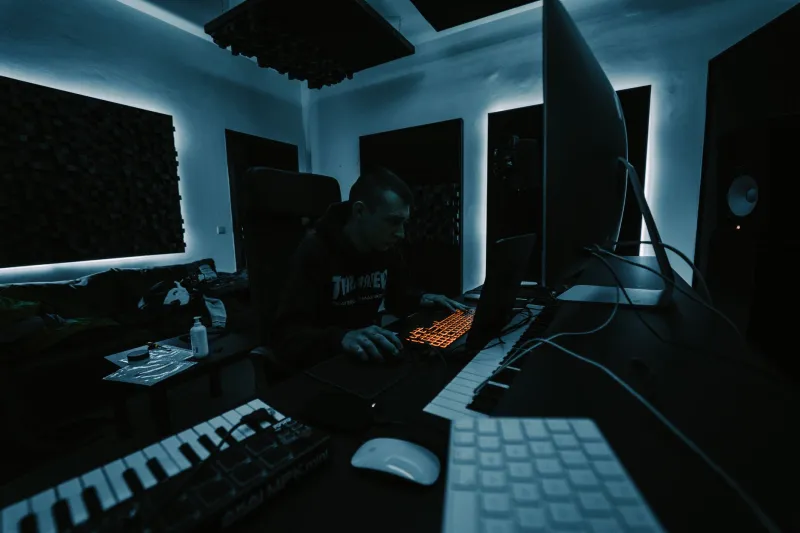
Somewhere in a studio apartment in Portland, a 24-year-old with a cracked copy of Ableton and a pair of secondhand headphones is doing something that would have seemed impossible to a 1960s acid evangelist: manufacturing a psychedelic experience without a single molecule of anything illegal.
The lo-fi movement — that warm, hazy corner of the internet that gave us rain-soaked study playlists and perpetually nodding anime girls — has quietly evolved into something far stranger and more interesting than background music for homework. A growing cohort of bedroom producers is deliberately engineering trance states, using layered synthesis, granular processing, and careful manipulation of rhythm and frequency to push listeners into perceptual territory that sounds, by all accounts, a lot like the early edges of a psychedelic headspace.
And most of them will tell you they didn't plan it that way.
The Accidental Cartographers
Ask any lo-fi producer how they stumbled into altered-state territory and you'll get some version of the same story: they were chasing a feeling, not a destination. The tools they use — granular synthesizers that chop audio into microscopic grains and reassemble them in shimmering clouds, pitch-shifted vocal samples that dissolve into something barely human, reverb chains so deep the original sound becomes a ghost of itself — are fundamentally deconstructive. They take recognizable audio and unmoor it from reality.
That process of unmooring, it turns out, is doing something specific to the brain.
Researchers studying the neuroscience of music perception have long known that the brain's default mode network — the same neural system disrupted by classical psychedelics like psilocybin and LSD — is heavily engaged during certain kinds of passive, immersive listening. When a track's rhythmic structure is subtle enough to bypass conscious pattern recognition but present enough to create a forward momentum, listeners enter a state of what some researchers call "absorbed attention." The internal monologue quiets. Time perception warps. The boundary between self and sound gets genuinely fuzzy.
Lo-fi producers, working entirely by instinct and aesthetic preference, have been building the exact sonic architecture that triggers this response.
The Toolkit of the Accidental Psychonaut
The technical ingredients aren't mysterious once you understand what they're doing. Granular synthesis — popularized in accessible tools like Ableton's built-in granular capabilities and standalone apps like Emergence — takes audio and fragments it into tiny grains, typically between 1 and 100 milliseconds long. Reassembling those grains in overlapping, slightly randomized patterns creates textures that feel simultaneously familiar and impossible to locate. Your brain keeps reaching for the source sound and keeps coming up slightly short. That cognitive stretch, repeated over minutes of listening, is exhausting in the most pleasant possible way.
Add to that the way lo-fi producers approach rhythm. Where traditional hip-hop production locks its drums to a grid with mechanical precision, lo-fi deliberately introduces what producers call "swing" or "humanization" — subtle timing variations that make the beat feel like it's breathing. Listeners' nervous systems sync to rhythmic patterns through a process called entrainment, and a rhythm that breathes irregularly keeps that synchronization slightly off-balance, producing a mild but persistent altered state of attention.
Frequency layering does the rest. Many lo-fi tracks embed low-frequency drones — sometimes deliberately tuned to frequencies associated with meditative brainwave states — beneath the more audible elements. You don't hear the drone so much as feel it. Combined with high-frequency shimmer from tape saturation effects and vinyl emulation plugins, the result is a listening experience that occupies your entire auditory bandwidth in a way that gently crowds out everything else.
Listeners Are Noticing
Scroll through the comment sections of the most popular lo-fi channels on YouTube — Lofi Girl alone has accumulated billions of plays — and you'll find language that belongs more to a trip report than a music review. Listeners describe time moving differently. They report visual hallucinations at the edges of their peripheral vision. Several describe a quality of emotional openness that they associate with meditation retreats or, explicitly, with psychedelic experiences.
This isn't marketing copy. These are ordinary people reporting genuine perceptual shifts from algorithmically curated playlists, and the producers behind the most consciousness-bending tracks are starting to take that feedback seriously.
Producers in communities like Reddit's r/LoFiHipHop and various Discord servers dedicated to ambient and experimental production have begun sharing techniques specifically aimed at deepening the listening experience — not just making pretty background music but engineering genuine immersion. The vocabulary they use borrows freely from psychedelic culture: "dissolving," "ego softening," "perceptual expansion." They're building maps of territory they found by accident and are now exploring on purpose.
The Streaming Algorithm as Trip Guide
There's a layer to this phenomenon that complicates the romantic narrative of the lone bedroom producer. Streaming platforms — Spotify in particular — have their own stake in keeping listeners in extended, immersive states. Algorithmic playlist curation actively rewards tracks that increase listening session length, and it turns out that consciousness-adjacent lo-fi does exactly that. A listener who enters an absorbed state is a listener who doesn't skip, doesn't switch playlists, and keeps the passive revenue flowing.
That's a genuinely weird dynamic. The same corporate infrastructure that the counterculture has historically opposed is now, inadvertently, funding and distributing the most accessible altered-state experiences available to the average American. You don't need money, connections, or any particular courage. You need Spotify, headphones, and about twenty minutes.
Whether that democratization is a beautiful thing or a commodification of something that should stay weird and difficult is a conversation the lo-fi community is actively having — and not entirely resolving.
What the Old Guard Thinks
The psychedelic art and culture community has had complicated reactions to the lo-fi consciousness phenomenon. Some longtime advocates for expanded perception celebrate it: anything that opens a door, they argue, is doing the work. If a college student in Ohio discovers that music can genuinely alter their perception, that's the beginning of a longer journey, not a shortcut that bypasses the real thing.
Others are more skeptical. There's a tradition within psychedelic culture that emphasizes difficulty, surrender, and genuine dissolution of ego as necessary components of meaningful experience. A mildly altered listening state achieved through clever synthesis is, in this view, a simulation — interesting but ultimately shallow, like looking at a photograph of a canyon instead of standing at the edge.
Both perspectives have something real to offer. What's undeniable is that something is happening in these headphones, in these bedrooms, in these algorithmically assembled playlists that the culture is only beginning to understand.
The Frontier Is Wherever You're Listening
Psychedelic culture has always been about expanding the definition of what's possible inside human consciousness. The tools change. The delivery mechanisms evolve. What stays constant is the impulse — the reach toward something larger, stranger, and more luminous than ordinary waking life.
Lo-fi producers aren't the first artists to engineer altered states through sound. Drone composers, minimalist classical musicians, and ambient pioneers like Brian Eno have been working this territory for decades. But the lo-fi movement has done something none of those predecessors managed: it put the tools in the hands of millions of bedroom artists and the results in the ears of billions of listeners.
The psychedelic experience, it turns out, was always partly a technology problem. And the kids with the laptops are solving it in real time.