Main Street Gets Its Third Eye: Inside Small-Town America's Secret Psychedelic Art Spaces
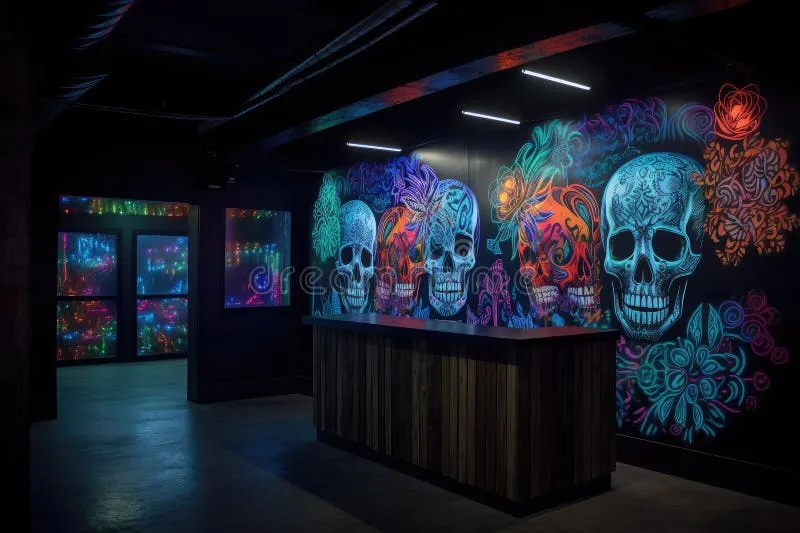
Photo: blacklight mural art collective abandoned warehouse interior, via thumbs.dreamstime.com
Drive through downtown Youngstown, Ohio, on a Friday night and you might notice something strange: a formerly boarded storefront glowing violet from the inside. Step closer and you'll find a blacklight room, a mural that seems to breathe under UV tubes, and about forty people who drove in from three counties to stand inside somebody's imagination.
This isn't Brooklyn. It's not even Columbus. And that's precisely the point.
Why the Movement Skipped the City
The conventional wisdom said immersive art needed urban real estate, deep pockets, and Instagram tourism. The collectives currently popping up in rust-belt towns, desert hamlets, and college burgs across the country have concluded the opposite: small towns are actually better.
The rent, for starters, is absurd. A warehouse that would cost $8,000 a month in Los Angeles can sometimes be had for a few hundred in eastern Ohio — especially when landlords are just relieved someone wants the building occupied. Add in the fact that small-town zoning boards tend to leave artist collectives alone as long as nobody causes trouble, and the math starts making itself.
But there's a deeper logic. Psychedelic art has always been about dissolving boundaries — between self and world, high and low, sacred and silly. What boundary is more rigid than the line between "art town" and "nowhere"? These collectives are dissolving it with paint, projectors, and plywood.
What a Converted Feed Store Offers That a Museum Can't
Museums show you art. These spaces put you inside it — and then hand you a brush.
Walk into one of these collectively run spots and the walls are rarely finished. Visitors add to murals. Installations get rebuilt between events. The feedback loop between artist and audience is measured in hours, not generations. There's no velvet rope because the rope would be a lie; this art is meant to be touched, added to, occasionally knocked over and remade.
There's also the matter of audience. In a small town, a psychedelic art space isn't one option among two hundred on a Friday night — it's often the thing happening. That concentration of attention produces crowds and energy that big-city galleries would kill for.
The Money Question
Nobody's getting rich, but the spaces are surviving, usually through a patchwork: art walk revenue, workshop fees, merch, memberships, and the occasional grant from state arts councils that are suddenly very interested in downtown revitalization.
The collectives have also gotten shrewd about events. Live music nights, projection shows, and community paint days generate cash and goodwill in equal measure. In several towns, the local chamber of commerce — yes, the chamber of commerce — now lists the psychedelic art space as a downtown attraction.
A Different Kind of Renaissance
What's emerging in these towns isn't a scaled-down version of the city scene. It's something with its own texture: slower, more communal, less curated. The artists aren't jockeying for gallery representation in Chelsea; they're building the gallery because there wasn't one.
And there's a quiet radicalism in the geography itself. The counterculture's visual language — the swirls, the sacred geometry, the blacklight bloom — was born in cities and marketed back to the masses. Now the masses are making it themselves, in towns the culture industry forgot, in buildings everyone else wrote off.
The third eye, it turns out, opens just fine on Main Street.