Eat the Vision: How Avant-Garde Chefs Are Turning the Dinner Table Into a Portal
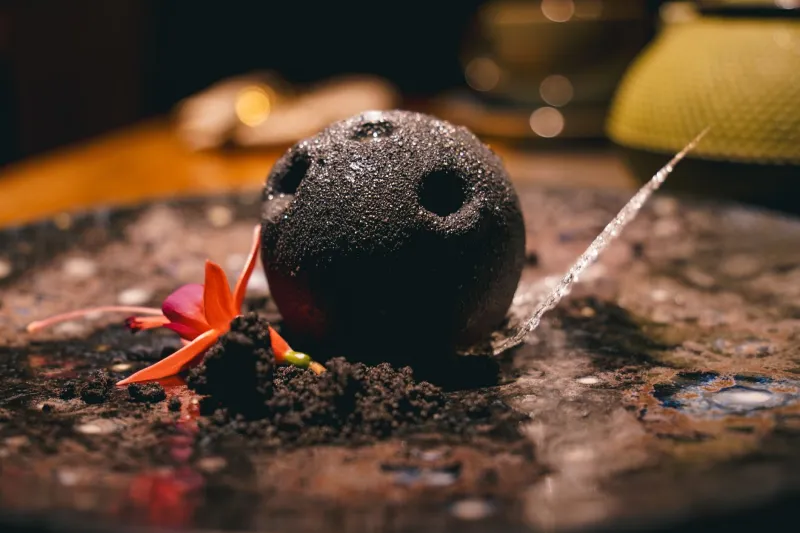
Somebody hands you a dish. The sauce spirals outward from the center like a mandala someone painted in slow motion. The foam on top shifts between lavender and gold depending on the angle of the candlelight. The smell hits before the fork does — something floral, something earthy, something you can't quite name but that makes the back of your skull hum. You haven't taken anything. You're just sitting at a table in a converted warehouse in East Austin, and a chef you found through a friend-of-a-friend Instagram DM is serving you what he calls "consciousness cuisine."
Welcome to the psychedelic kitchen. No substances required.
Plating as a Practice
The overlap between psychedelic aesthetics and food has been bubbling underground for years, but it's hitting a different frequency right now. A growing network of chefs, food artists, and culinary experience designers across the US are treating the dinner plate the way a visual artist treats a canvas — as a site of intentional perception disruption.
Chef Marcus Delray, who runs an invitation-only supper club out of a rented loft space in Chicago's Pilsen neighborhood, puts it plainly: "I'm not trying to feed you. I'm trying to move you." His eight-course tasting menus are built around what he calls "chromatic progression" — a deliberate sequencing of colors, textures, and temperatures designed to shift your mental state as the meal unfolds. The first course is all whites and pale yellows, light and almost translucent. By course five, you're deep in jewel tones — beets processed into near-black, saffron emulsions that look almost radioactive. "Color changes your brain chemistry," he says. "That's not woo-woo stuff. That's neuroscience."
He's not wrong. Research on color psychology and appetite has existed in mainstream food science for decades, but Delray and his peers are pushing that logic somewhere the food industry's marketing departments never intended. They're not using color to make your fast food look more appetizing. They're using it to engineer a kind of waking altered state.
Molecular Gastronomy Meets Expanded Consciousness
The tools of molecular gastronomy — spherification, edible gels, flash-freezing with liquid nitrogen, emulsification techniques borrowed from chemistry labs — have given this generation of underground chefs a vocabulary that maps almost perfectly onto psychedelic visual language. Think about it: a dish where a single drop of citrus oil blooms outward through a clear broth like a fractal. A dessert where edible iridescent powder catches the light and makes your brain momentarily lose its grip on depth perception. A savory course where the texture shifts so dramatically mid-bite that your nervous system genuinely doesn't know what category of experience it's processing.
Lena Voss, a food artist and former chemistry PhD candidate who now runs pop-up dining events in the Bay Area, describes her work as "synesthetic engineering." Her events pair each course with a specific sonic environment — frequencies calibrated to complement the flavor profiles she's designed. "Sound changes how we taste. Light changes how we taste. Temperature, texture, smell — all of it is talking to your brain at the same time," she explains. "Most restaurants treat those as afterthoughts. I treat them as the whole point."
Voss's events regularly sell out within hours, spread almost entirely through word of mouth and a carefully managed email list. Tickets run between $180 and $350 per person. The waitlist is months long.
The Ethics of the Aesthetic Plate
Not everyone in the culinary world is enthusiastic about this direction. Critics — and there are some vocal ones — raise legitimate questions about access, gatekeeping, and what happens when "consciousness exploration" becomes another luxury product for people who can already afford to expand their horizons.
There's also a more pointed critique: some of these experiences flirt with psychedelic symbolism and language in ways that flatten the actual cultural and spiritual traditions those aesthetics come from. When a $300 tasting menu describes itself as a "shamanic journey through flavor," it's worth asking whose traditions are being borrowed and whether anyone's giving credit where it's due.
Delray acknowledges the tension. "I think about it constantly," he says. "There's a version of this work that's genuinely transformative and a version that's just expensive Instagram content. I'm trying to be in the first category. I'm not always sure I succeed."
The best chefs in this space seem to hold that question with them rather than deflecting it. Voss has started incorporating explicit educational components into her events — brief talks about the science of perception, the history of synesthesia research, the indigenous traditions that understood multisensory experience long before any food scientist gave it a name.
What Your Brain Does at the Table
Here's the science piece that makes all of this more than just vibes: the human brain processes a meal as a full-system event. Taste is only one input among dozens. The McGurk effect, crossmodal perception, and decades of sensory science research all confirm that what you see, hear, smell, and feel while eating fundamentally shapes what you taste. This is why airline food tastes worse than it actually is (cabin pressure and noise genuinely dull your palate), and it's why eating alone in front of your laptop is a completely different experience than eating the same food at a beautifully set table with candlelight.
The chefs doing this work aren't hacking your brain with substances. They're using the hardware your brain already has — its tendency to synthesize sensory inputs into unified experiences — and they're pushing it to its edges. That's not so different from what a great visual artist does. Or a great musician. Or, yes, a psychedelic experience.
The Underground Table Is Set
What's striking about this scene is how deliberately it exists outside mainstream food culture. These aren't Michelin-starred restaurants running a trendy tasting menu. They're supper clubs operating through Signal groups and encrypted email lists. They're pop-ups that appear once in a borrowed gallery space and then dissolve. They're dinners hosted in someone's home for twelve people who all know someone who knows someone.
There's something intentional about that insularity. Part of what makes these experiences work is that they exist outside the ordinary rhythm of consumer culture. You can't just show up. You have to seek it out. The seeking is part of the experience.
That's very much in line with how the broader psychedelic art world operates — the idea that the most meaningful aesthetic experiences require some effort to access, that they exist in the margins by design. The underground table isn't underground because it's hiding. It's underground because the surface world isn't ready for what's being served.
If you're lucky enough to get an invite, clear your schedule. And maybe skip lunch.