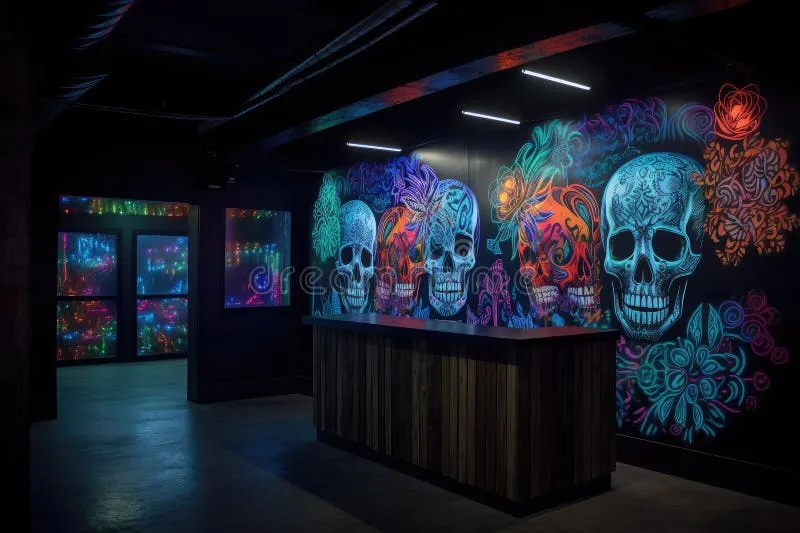
Beautiful, Wrong, and Yours: Inside the Collector Stampede Toward Bad-Trip Art
Photo: dark surreal psychedelic painting on gallery wall, via www.heavenofhorror.com
There's a painting in a gallery in Portland that I could only look at for about eleven seconds at a time. A face made of teeth and circuit traces, lit from below in a green that does not occur in nature, hanging above a title card that says only Nausea Studies No. 4. It sold before the opening ended. The asking price was $6,800.
Ten years ago, that piece would have been a t-shirt. Fifteen years ago, a basement mural. Now it's on a white wall with a red dot next to the label, and there's a waitlist for the artist's next show.
Welcome to the bad-trip wing of the psychedelic art market, where the imagery that was never supposed to be pleasant is suddenly the most interesting thing collectors can buy.
How We Got a Dark Room
The psychedelic tradition always had a hard edge to it. Both things are true: the movement made poster art that looked like a sunrise, and it also made art about losing the map. The 1960s underground comix were full of devils and bad chemicals. The 1970s and '80s biomechanical stuff out of Europe leaned hard on bodies that had been reorganized incorrectly. Nineteen-nineties zine culture and death-metal sleeve art ran the whole thing through a photocopier until it looked like a threat. Somewhere along the way, that lineage got filed under "creepy" and left out of the curated story.
What's changed is that a generation of collectors who grew up with all of it — horror, manga body horror, glitch, the unhinged corners of the internet — doesn't separate the sublime from the upsetting. That separation was always a marketing decision anyway.
Why Discomfort Reads as Honest in 2026
Part of this is exhaustion with the ambient wall art of the last decade. A lot of the bright, sacred-geometry, everything-is-connected print market got extremely safe. It's pretty. It's also a scented candle.
And part of it is the room we're all standing in. Collectors I talked to kept using the same word: accurate. A stretched, distorted figure with too many eyes doesn't read as fantasy in 2026. It reads as a fair description of the news cycle, the algorithm, the climate maps, the way everything arrives at once and none of it resolves. When the world feels like a bad trip, art that admits it looks more trustworthy than art that insists everything is beautiful.
There's an art-historical name for this, by the way. Anxious eras produce anxious ornament. It's not a new story; it's just our turn.
What Counts as Bad-Trip Art — and What's Just Ugly
This is where buyers get into trouble, because "disturbing" is doing a lot of work in a lot of sales listings. Three rough categories:
- Crafted dread. Work with real control behind the unpleasantness — deliberate color, deliberate composition, a maker who knows exactly which nerve they're hitting. This is what the market is paying for.
- Shock as substitute. Gross-out imagery with no structure underneath it. Fun for a poster, thin for a collection. It doesn't age, it just gets boring.
- Accidental discomfort. Amateur work that's unsettling because it's unresolved. Some of it is genuinely great outsider art. Most of it is a bad drawing with a good frame.
The tell, I think, is whether the piece rewards a second look. If you keep finding new things in the wrongness, somebody built that. If it's flat after twenty seconds, they didn't.
The Pricing Problem
Here's the part where I wave my hands. This market is young and thin. Price discovery is mostly vibes plus Instagram, and the spread between what an emerging artist asks and what a flipper lists is enormous. I watched one artist's small canvas go from $400 at a group show to $2,900 online in eighteen months with no significant change in the work.
A few guidelines that will keep you from being the exit liquidity:
- Buy the artist, not the mood. The mood will rotate. A serious practice accumulates value; a scary image doesn't.
- Buy from the studio. Primary sales pay the maker. Resale sites pay the flipper.
- Ask about edition size and reproduction rights. Dark imagery gets screenprinted fast, and a print run can dent the value of a canvas's image.
- Get the story in writing. Provenance, date, materials, and any exhibition history. Future buyers will ask.
- Never buy as an investment. This is the least liquid corner of an illiquid category. Buy it because you want to live with it.
Living With It
Which is the actual question, isn't it? Because unlike a print of a mandala, a hostile image becomes part of your interior life. Lighting matters more than you'd think — dark palettes go muddy in a dim room and loud under direct sun, and the wrong frame can turn menace into kitsch. A deep black frame and a low, warm light does a lot of work. A thin gold frame will make your nightmare look like a hotel lobby.
And be honest about your tolerance. I know two collectors who bought hard pieces and then hung them in a hallway they never walk down. That's not ownership, that's storage with extra steps.
Where This Goes
My guess is the market splits, the way every fringe category does once money finds it. One branch goes decorative — sanitized bad vibes, sold at mall prices, skulls on phone cases. The other branch gets institutional, starts showing up in group exhibitions about anxiety and technology and gets written about in the same breath as the historical surrealists.
The interesting thing about the bad-trip wing is that it refuses the wellness framing the psychedelic mainstream has been selling. No journey, no healing, no integration. Just a picture of a mind that's struggling, rendered with skill, offered without an apology. In a scene that's spent a decade insisting it's good for you, that honesty is worth more than the price tag. Even when the price tag is $6,800.